Pay in installments of $7.01 with
 ,
,
 and
and

Shipping Estimate
USA
- USA
- CAN
- USA
- CAN
Ships within 48 hours · Estimated delivery Jun 28 - Jul 3
 Promo Codes Available:
For Your Every Summer RSVP, with Code: SUMMER15
Description
where to buy pomegranate seeds to plant Pomegranate Tree Seeds — Punica granatum | Heat-Tolerant FruitSix thousand years of cultivation. Infinitely worth it. Punica granatum, the Pomegranate, is one of the oldest cultivated fruit trees in the world, grown by humans across the Middle East, Mediterranean, and South Asia for at least 6,000 years. Its brilliant orange red flowers, glossy foliage, and jewel like fruit filled with sweet tart arils have made it one of the most symbolically rich trees in human history, appearing in the art and mythology of
Six thousand years of cultivation. Infinitely worth it.
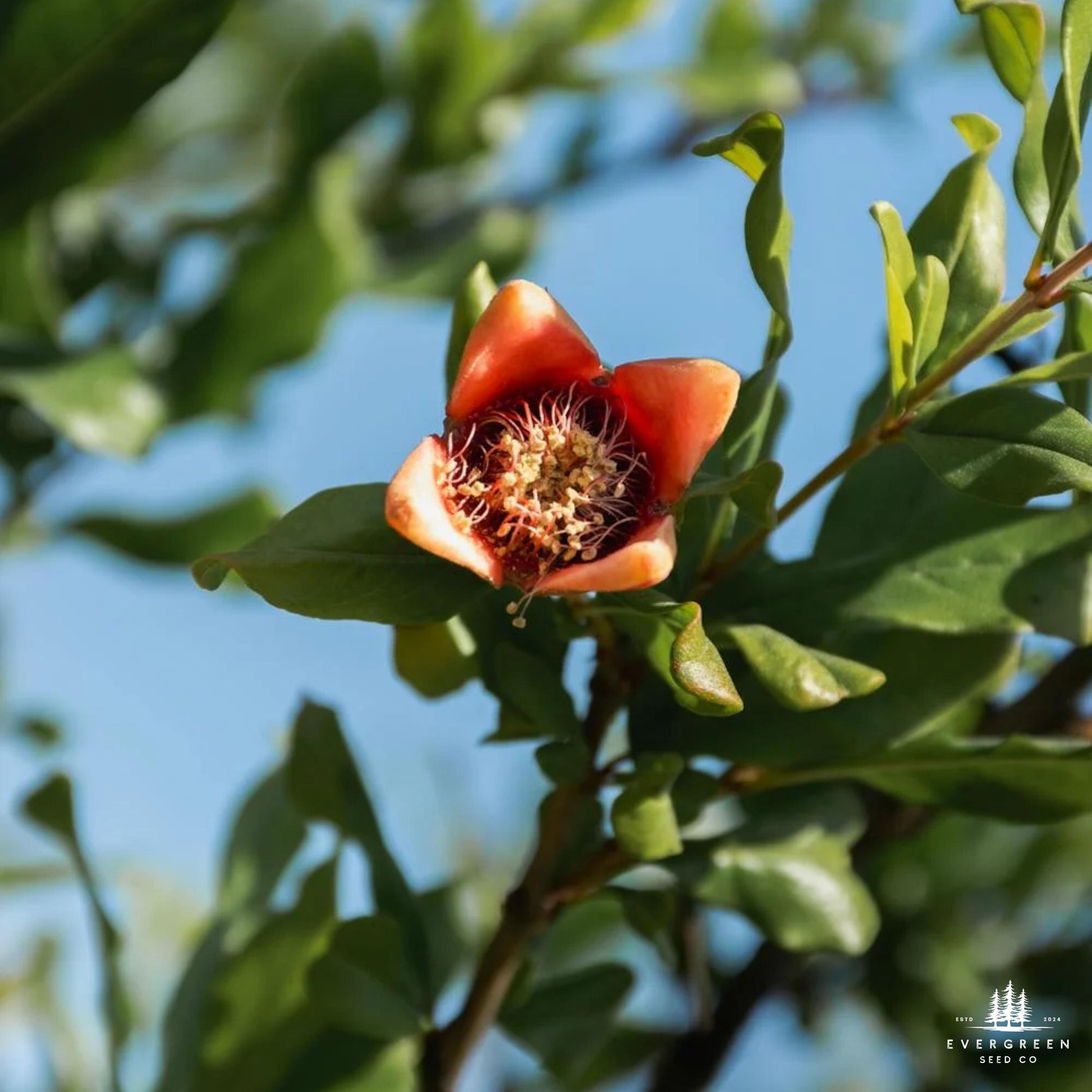
Punica granatum, the Pomegranate, is one of the oldest cultivated fruit trees in the world, grown by humans across the Middle East, Mediterranean, and South Asia for at least 6,000 years. Its brilliant orange-red flowers, glossy foliage, and jewel-like fruit filled with sweet-tart arils have made it one of the most symbolically rich trees in human history, appearing in the art and mythology of ancient Egypt, Greece, Persia, China, and countless other civilizations. It is also a genuinely productive edible tree that tolerates drought, heat, and alkaline soils that defeat most other fruit trees, making it one of the most rewarding options for warm-climate growers. If you are looking to buy Pomegranate seeds or grow pomegranate from seed, you are participating in a cultivation tradition that predates written language.
- One of the oldest cultivated fruit trees in human history, grown continuously for over 6,000 years
- Brilliant orange-red flowers with multiple blooms per season providing extended ornamental interest
- Adaptable to drought, heat, alkaline soils, and neglect once established
- Rich, sweet-tart fruit filled with antioxidant-dense arils, one of the most nutritionally studied fruits available
- Can be grown as a specimen tree, large shrub, or container plant in colder climates
Things you probably did not know about the Pomegranate
It appears more times in ancient art than almost any other plant. Pomegranate imagery appears in ancient Egyptian tomb paintings, Phoenician jewelry, Greek pottery, Persian rugs, Jewish ceremonial objects, Roman mosaics, and Chinese porcelain spanning thousands of years across dozens of cultures. No other fruit has been used as a visual symbol across so many civilizations simultaneously. It represented fertility, abundance, and immortality in virtually every culture that grew it.
The seeds were preserved in the tomb of Tutankhamun. When Howard Carter opened the tomb of Tutankhamun in 1922, among the thousands of artifacts was a wooden box containing dried pomegranate seeds placed there over 3,300 years earlier. The seeds were intended to nourish the pharaoh in the afterlife, reflecting how deeply important the pomegranate was in ancient Egyptian culture.
Pomegranate juice has been studied in more clinical trials than almost any other fruit. The polyphenol content of pomegranate juice, particularly punicalagins and anthocyanins, has been the subject of hundreds of peer-reviewed studies examining cardiovascular effects, anti-inflammatory properties, and antioxidant activity. The research output has made pomegranate one of the most scientifically scrutinized foods available.
Seed-grown pomegranates show remarkable variation. Unlike clonally propagated nursery trees, pomegranates grown from seed produce a range of fruit characteristics including variations in fruit size, aril color, sweetness, acidity, and seed hardness. Occasional seedlings produce fruit superior to the parent. Growing from seed is the traditional way new pomegranate varieties are discovered.
Growing Details
- Botanical Name: Punica granatum
- Stratification: Not required
- USDA Zones: 7 to 11 as a perennial, zone 6 with winter protection, excellent container plant in colder climates
- Soil: Adaptable, tolerates poor, dry, or alkaline soils, does not tolerate waterlogged conditions
- Light: Full sun
- Height: 12 to 20 feet
- Spread: 12 to 15 feet
- Growth Rate: Moderate, 1 to 2 feet per year
Plant it in the hottest, sunniest spot you have and harvest the fruit when the skin turns deep red and the crown at the top splits slightly. That is when it is ready.
Shipping Notes
- Free Standard Shipping on $100+ Orders to the USA.
- Except Preorder products are shipped in 48 hours.
- Delivery to the USA:
- Standard Shipping : 3-10 business days
- If time is of the essence, please consider selecting expedited delivery for faster service.
Exchange/Return Notes
- We offer a 30-day return/exchange service after receiving.
- Final sale items are not eligible for returns or exchanges.
- To process your return/exchange, please contact us at [email protected]
- Please click here for more details>>> Return & Exchange Policy